
Is Your Business Growing, or Just Drifting?
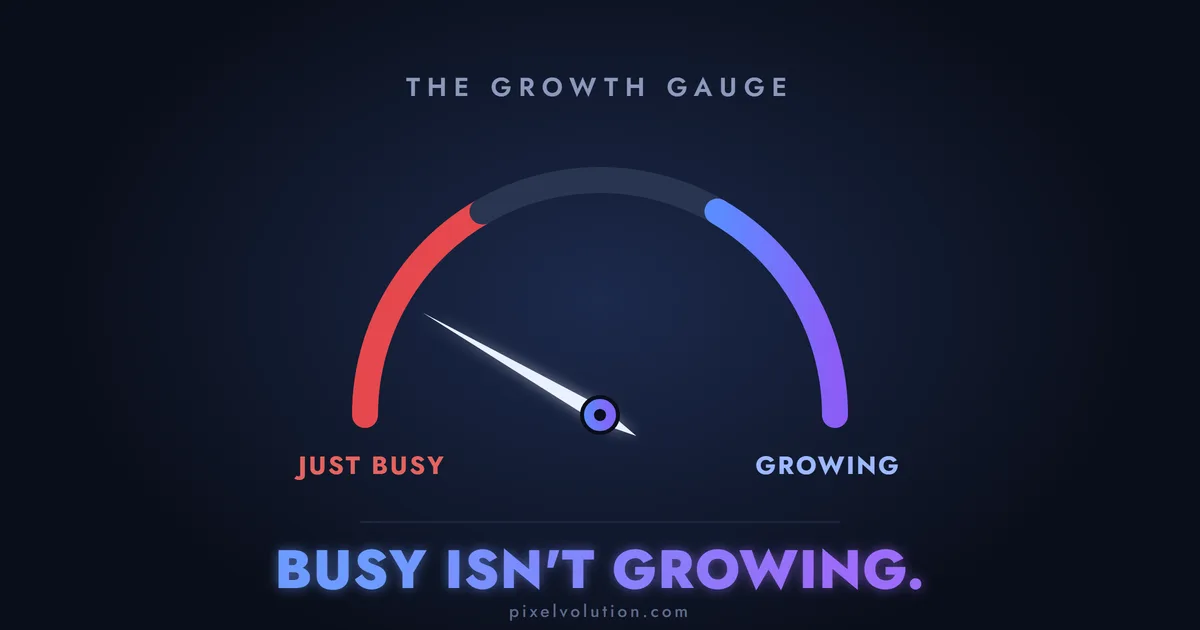
You had a busy year. You worked your tail off. The trucks ran, the phone rang, the calendar stayed full. But be honest with yourself for a second. Are you actually further ahead than you were a year ago, or are you just more tired?
That's the question nobody wants to sit with, because the answer can sting. A lot of good owners are busier than they have ever been and not one inch further down the road. Busy feels like progress. It even feels like growth. But the two are not the same thing, and the gap between them is where businesses quietly stall out.
Busy and growing are not the same thing
Busy means your calendar is full. That's it. It says nothing about whether your business is worth more, runs smoother, or leans on you less than it did last year.
Growing means the business itself is getting stronger. More repeat customers. Better jobs, not just more of them. A name people pass around. Money left over after the dust settles. Something that doesn't fall apart the week you take off.
You can be slammed every single day and still be drifting. Drifting just means motion with no direction. The engine is running, you are burning fuel, but you are not steering anywhere. And it is sneaky, because from the driver's seat drifting feels exactly like driving.
The quiet signs you're drifting
Here's the gut check. If a few of these sound like you, you are probably busier than you are better off.
- Every month starts from zero. You are only as good as this month's leads. Last month's work didn't build anything that carries forward.
- You are the business. If you stop, everything stops. That's not a business you own. It's a job that owns you.
- You're renting customers, not keeping them. You are always chasing the next new one and rarely hearing from the last one.
- You don't really know your numbers. You know what came in. You're fuzzy on what you actually kept.
- You're the busiest you've ever been, and no richer for it. More work, same bank account, more stress.
- Same headaches as last year, just bigger. The problems never got solved. They just scaled up with you.
None of this means you're bad at your trade. It usually means all your energy goes into doing the work, and none goes into building the thing that does the work.
Where Google Ads quietly fits in
This is the trap I see most. Ads feel like growth because the phone rings the day you switch them on. Look closer though.
You are buying clicks in one of the most expensive auctions on the internet. The average trade click runs about $8. But the urgent, ready-to-hire searches, the ones you actually want, go for a whole lot more. I pulled the going rate on a few:
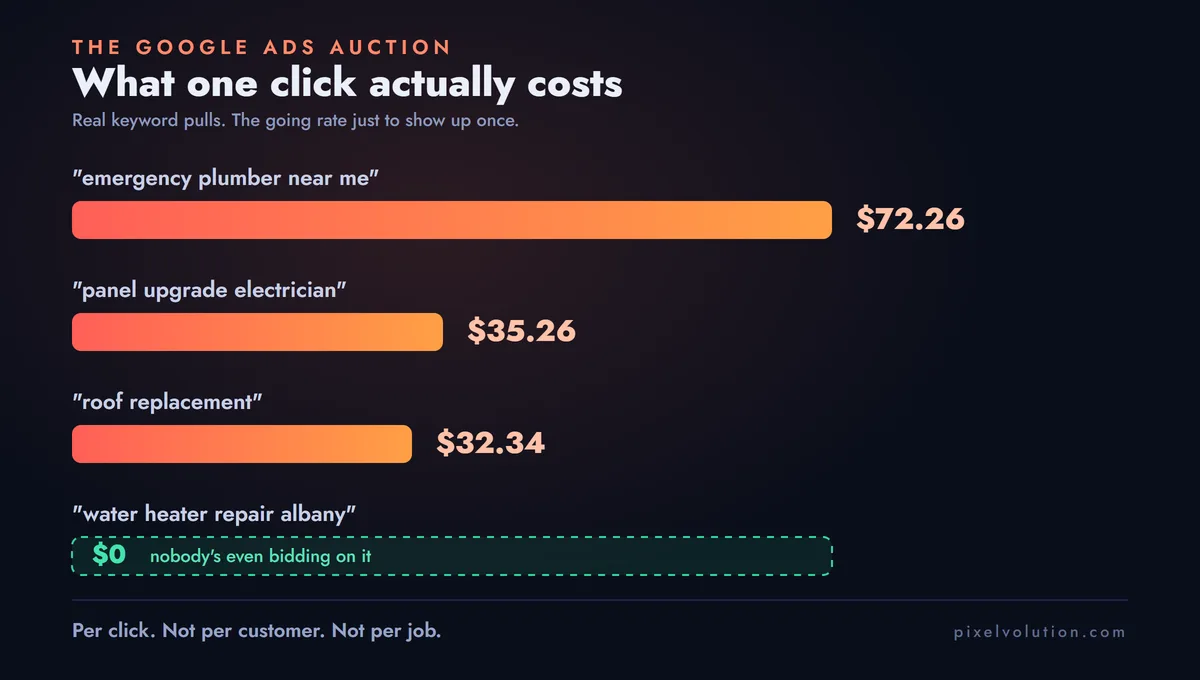
Read that top one again. Seventy-two dollars for one person to tap your ad, and they might bounce before the page even loads. That's per click, not per customer, and not per job. You pay it for the tire-kicker, the wrong number, and the competitor checking your price, same as the real lead.
Now look at the bottom one. "Water heater repair albany" costs basically nothing, because almost nobody is bidding on it. That's not a fluke, and it's the most important line on that chart. The big, broad, panic searches are a bidding war you pay through the nose for. The specific, local ones are wide open. And those wide-open local searches are exactly the ones you can win for free with one good page, instead of renting them by the click.
Here's the other part that matters. The moment you stop paying for the expensive stuff, it all goes dark. The phone goes quiet that same afternoon. That is not a business growing. That is a meter running. Ads have a real place, when you're brand new with no reputation yet, or you have a slow season to fill, or there's one high-margin service worth bidding on. But if ads are your whole engine, you don't have growth. You have rent with a receipt.
What actually moves you from drift to growth
None of this is about a fancy website or a new logo. It's about building something that carries forward instead of resetting to zero every month.
Mine the customers you already have. This is the cheapest growth there is, and almost nobody does it. Landing a brand-new customer costs five to twenty-five times more than keeping one you already earned. Your past customers already trust you. They book again, they spend more, and they tell their friends. A small bump in repeat business does more for your bottom line than a pile of cold leads ever will.
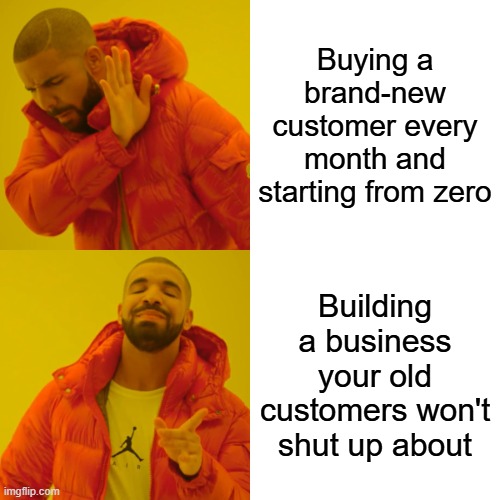
Call the folks you did good work for last year. Ask for the review. Ask for the referral. Send the reminder when the next service is due. That phone in your pocket is a goldmine you already paid for.
Know your numbers. Not just what came in, what you kept. Which jobs actually make money and which ones quietly bleed you. Which customers are worth chasing and which ones cost more in headaches than they pay. Revenue is vanity. Profit is what keeps the doors open.
Make yourself replaceable in the day-to-day. If the whole thing only works when you are personally holding it together, you've built a job, not a business. Start writing down how you do things. Hand off the parts someone else can do. A business that can run a week without you is worth something. One that can't, isn't.
Pick a direction on purpose. Drifting is what happens when you take whatever job rolls in and never choose. Decide what work you want more of, which customer you actually want, and point the whole business that way. A boat with a rudder beats a boat with a bigger engine.
Protect your reputation like the asset it is. Your name around town is the one thing that grows while you sleep and can't be switched off like an ad. Every good job, every honest answer, every review is a deposit. It compounds for years. Nothing you can buy beats it.
The honest truth
Drift is comfortable because it looks just like hard work. You're tired at the end of the day either way. The difference is whether you wake up next year stronger, or just running the same loop a little faster.
A full calendar is not the same as a growing business. The owners who get ahead are the ones who step off the treadmill long enough to look at the gauge and ask the honest question. Busy, or actually growing?
If you want a second set of eyes on where your business is drifting and where it could be building, tell me a little about it. No pitch. I just like helping good operators stop spinning their wheels.
Where the numbers come from
Google Ads cost-per-click benchmarks by industry (WordStream)
The cost of acquiring a new customer vs. keeping one (Invesp)