
Your Website Isn't Aging Like Wine. It's Aging Like Milk.
Here is the fantasy every business owner buys into: you pay for a website once, it goes live, and then it just sits there earning its keep forever. Like a nice bottle of wine in the cellar, quietly getting more valuable while you ignore it.
Cute story. Wrong beverage.
An unattended website ages like milk. It doesn't announce that it has turned. There is no dramatic curdle, no smell that hits you when you walk in the door. It just gets a little worse every week, in a fridge nobody opens, until one day you wonder why the calls dried up and decide it must be "the economy."
Let me explain what is actually happening in there.
SEO is graded on a curve, and you skipped class
The thing nobody tells you about search rankings: you are not being marked against a standard. There is no passing grade you hit once and keep forever. You are being marked against every other business in your market, and a good number of them are updating their sites while you are not.
So doing nothing is not "holding steady." It is standing still on an escalator that is going down. Your competitor adds a page, freshens their content, speeds up their site, and slides right past you. You didn't do anything wrong. You just didn't do anything. In a race, that is the same thing. (If you have felt this happening but couldn't name it, that is the difference between growing and just drifting.)
Now the costs, in rough order of how much they will annoy you.
1. Google has the attention span of a gossip
Google likes what is new. It has entire systems built around liking what is new. Its own ranking systems documentation openly describes "query deserves freshness" systems that push fresher content up for the searches where people expect it.
There is a quieter problem underneath that. Search engines crawl sites that change more often. Let yours go stale and the crawlers stop dropping by as much, which means even the good changes you finally get around to take longer to count for anything. You have trained Google to expect nothing from you, and Google, being an excellent listener, delivers exactly that.
Translation: fewer of the people searching for the thing you sell ever see your name.
2. Your site developed a limp
Websites get slow and creaky the same way a garage fills with junk. New photos nobody bothered to compress. Old code. A plugin doing three jobs badly. Meanwhile the phones and browsers your customers use kept getting faster and pickier.
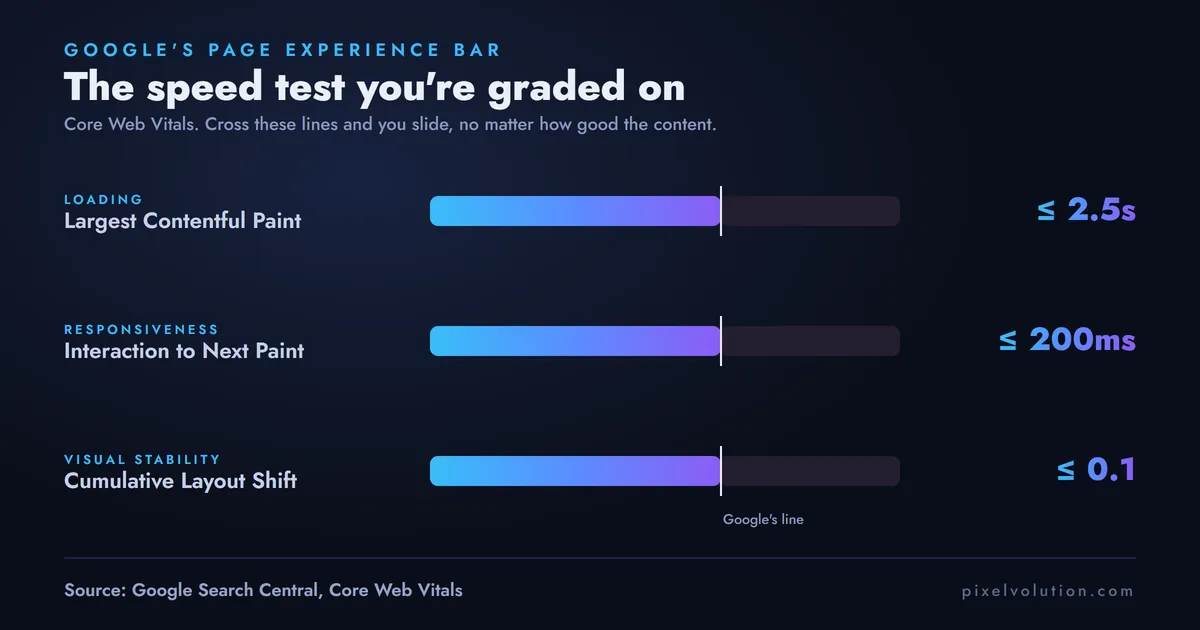
Google measures this now, with Core Web Vitals, and confirms they are used by its ranking systems. The bar is not vague: your main content should load in under 2.5 seconds, respond to a tap in under 200 milliseconds, and stop jumping around while it loads. A site left alone for three years usually whiffs on all three, which costs you twice. Once in the rankings, and once when the visitor who did find you gives up waiting and bounces to someone faster. Slow sites leak customers, quietly, all day long.
3. The stuff that broke while you weren't looking
This is my least favorite one, because it is the quietest and the most expensive.
Links rot. Pages you once linked to die, and now you are marching customers and crawlers straight into dead ends. Forms break. And here is the part that should keep you up at night: a contact form can stop sending emails and give you zero warning that anything is wrong. It still flashes "thanks, we'll be in touch." It just isn't in touch, because the message went absolutely nowhere.
I have seen a form sit broken for months. Every lead that came through it in that stretch simply evaporated. Not a slow decline. Work that was already yours, gone somewhere you never thought to look. That is the whole ballgame right there.
4. The security dumpster fire
If your site runs on WordPress and nobody is updating it, you are leaving the back door open in a neighborhood full of raccoons.
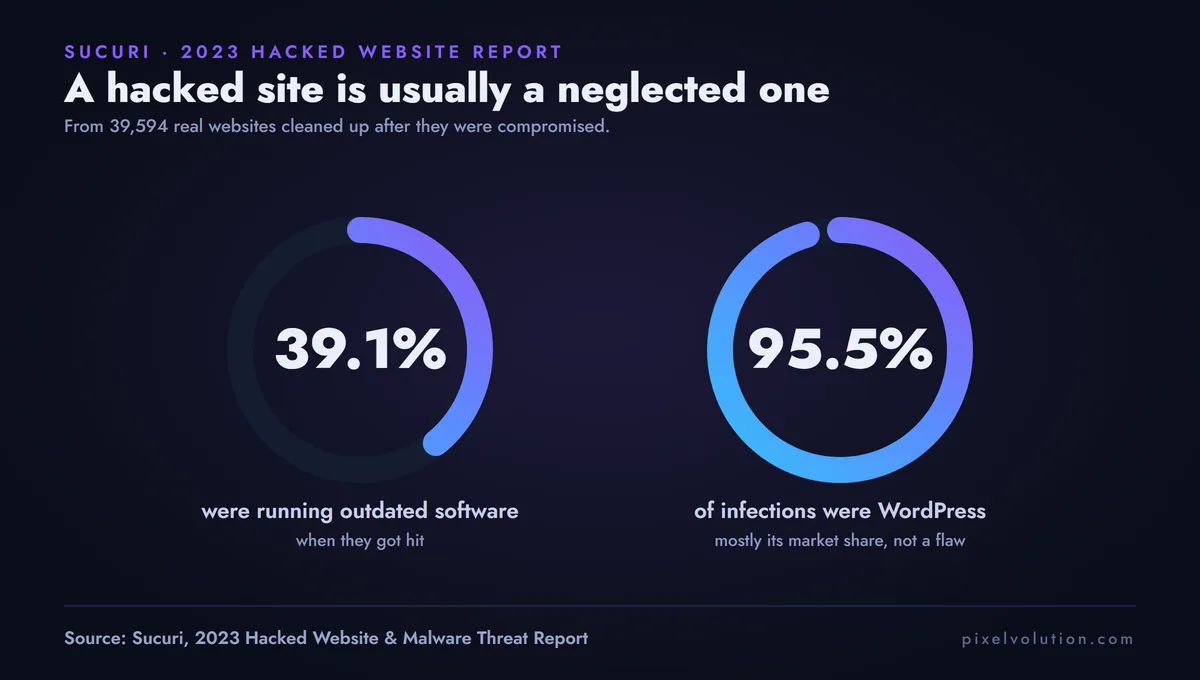
The numbers are not gentle. Sucuri's 2023 hacked website report found that 39.1% of the CMS sites they cleaned up were running outdated software when they got hit. WordPress turned up in 95.5% of infections, and in fairness to WordPress, that is mostly because it runs the majority of the web, not because it is flimsy. Ignore the updates on any platform, though, and you are the target.
Here is the punchline you really do not want: when a site gets hacked, Google notices, and it will happily stamp a "this site may harm your computer" warning right there in the results next to your name. Your traffic does not dip. It flatlines. And cleaning that mess up costs a great deal more than the boring maintenance that would have prevented the whole thing.
5. "Wait, are these guys even still open?"
Half of this isn't even technical. It is the copyright date in the footer that still says 2019. The hours that are wrong. The service you quit offering two years ago, still front and center. The staff page starring two people who don't work there anymore.
A customer lands on that, does the math, and quietly decides you went under. Then they call the competitor whose site looks alive. You didn't lose that job on price or on quality. You lost it because your website looked like a house with all the lights off.
The genuinely unreal part: it compounds
None of these send you a bill. That is the trap. No invoice, no red light on a dashboard. Just a little less every month: a few rankings, a few leads, a little trust.
And it stacks. The rankings you lose get harder to win back the longer they are gone, because now you have to climb past everyone who passed you while you were away. The leads you miss are not a one-time loss, they are every month's missed calls, over and over, until you actually fix the leak. It is deferred maintenance on a work truck. Skip the oil changes long enough and the eventual repair bill makes the maintenance you "saved" look adorable.
So, go check the fridge
None of this is a doom sermon. A website that gets a little attention on a schedule holds its value and keeps pulling its weight, and keeping it alive is dramatically cheaper than resurrecting it after it has gone sour. A lot of the upkeep, the fresh content and the review requests and the small recurring stuff, can even be handed off to tools that just do it so it never falls off your plate.
If you have no real idea what shape your site is in right now, that is normal, and it is fixable. Run it through my free site analyzer and it will tell you what is quietly rotting in there. Or just talk to me and I will take a look and give it to you straight: what is fine, what is leaking, and what is genuinely on fire.
Your website is not wine. Nobody's is. But milk you actually keep an eye on is just, you know, milk. Perfectly good. Go check the carton.